Disclaimer: You don’t find a black hole in black socks.
Introduction
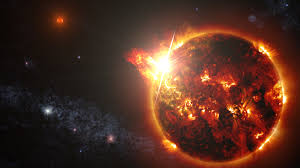
You see that star? No? Good, because it’s dead. You might be wondering, why is it so distorted there? It’s because there’s a black hole there.

The space around the black hole appears distorted due to a phenomenon called gravitational lensing (which we shall tackle soon). For now, check out this cool GIF on gravitational lensing,

some light of the galaxy.
You might now be wondering, what do these terms – ‘black holes’ and ‘gravitational lensing’ mean? Without further ado, let’s begin learning about them!
Stages of Death
To explore these, let’s jump inside our very own Sun!

is the only thing of importance to us right now.
Hmm, it still doesn’t add up. Let’s go even deeper, right into the core!

it’s 14 million kelvin in this picture.
What’s this mess you ask? This, (drumroll please) is nuclear fusion.
It’s the reason why the Sun shines. Why all life exists. Why you’re reading this right now instead of doing the other work you’re supposed to be doing.
Try to recall your 8th grade physics a little. Remember, that when you heat an object, it’s atoms gain kinetic energy and begin colliding with each other?
Similarly, in the Sun’s core, (where temperatures reach around 14 million kelvin) the Hydrogen atoms get agitated and start colliding, at high speeds. This causes the natural electrostatic force of repulsion (between their nuclei) to get overcome, causing them to fuse, into a heavier element – Helium.
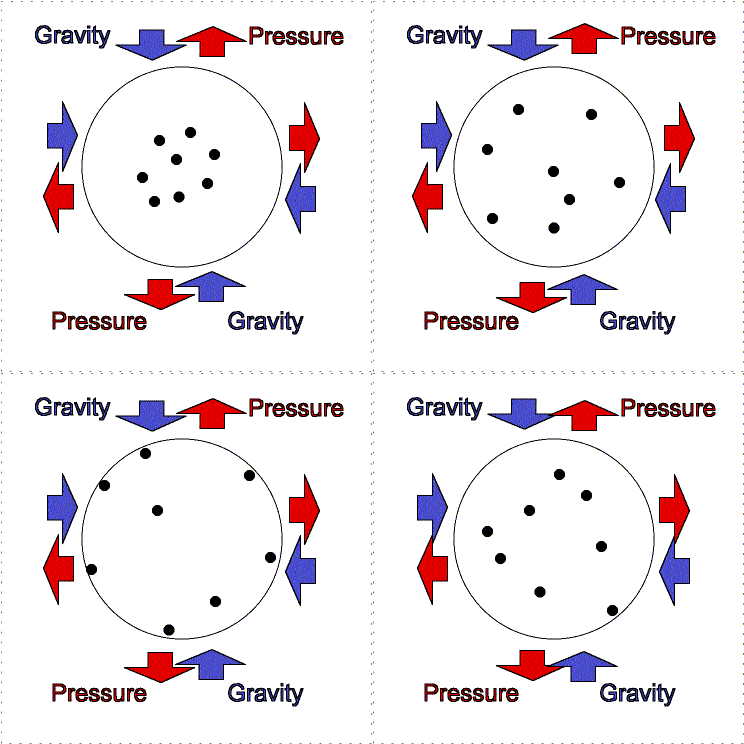
This releases a tremendous amount of energy in the form of radiation, which pushes against gravity. (FYI, the technical words for this is hydrostatic equilibrium.)

Yellow background – depicts the inside of the Sun.
White arrows pushing outwards – depict radiation energy due to fusion.
Orange arrows pointing inwards – depict the force of gravity acting on the core.
The Sun is primarily made up of Hydrogen and Helium. In the core, the fusion of He atoms radiates energy, causing the Sun to shine. However, gravity tries to compress the Sun to its centre.
It’s like a balloon. In a balloon, the gas inside the balloon pushes outward, but the material of the balloon provides sufficient inward compression to balance the pressure exerted by the gases inside.
Coming back to the Sun, the energy radiated from the core balances out the force of gravity, which compresses it into the most compact shape possible, a sphere.
NOTE: I’m not going to get into the details of nuclear fusion, especially how it works in the Sun, because that involves quantum tunneling and frankly, it’s a topic for another post.
Now, in stars waaaaaaay bigger than the Sun, the heat and pressure inside the core allow them to fuse Helium into even further elements, until they reach Iron. It’s like the layers of an onion.

Unlike all the elements before, the process of fusion giving Iron doesn’t generate any energy, causing Iron to build up at the core. It just starts to stack up.
Once the core passes a certain limit of mass, the balance between gravity and radiation energy is broken. The star implodes. This feeds the layers of mass into the core.

The star dies, in a majestic supernova explosion. This produces a black hole.
NOTE: However, this is not necessary. There are 2 types of supernovas. They could also produce neutron stars. But, these will be dealt with later. In our case, the star is waaaaaaay bigger than the Sun.
Here’s a representation of the process:

Black Holes
When you look at the black hole, what you’re really looking at, is the event horizon. The reason you can’t escape one is because the gravity in a black hole is so strong that you need to be moving faster than light to escape, which, according to General Relativity, is impossible.

From the outside, you can’t tell what is inside a black hole. You can throw television sets, books, or even your worst enemies into a black hole, and all the black hole will remember is the total mass, and the state of rotation.
Falling through the event horizon is kinda like falling over Niagra Falls. Till a certain limit, you can still swim against the current and get away, but, after that point, the flow of the current just washes you over the falls.

Similarly, if you fall towards a black hole feet first, gravity will pull harder on your feet than your head, because they are nearer the black hole. The result is, you will be spaghettified. The center of a black hole is called a singularity, and it’s one dimensional point, which contains a huge mass in an infinitely small space, where density and gravity become infinite and space-time curves infinitely. It is at this point, that our current physics breaks down.
Although you wouldn’t notice anything particular as you fell into a black hole, someone watching you from a distance would never see you cross the event horizon. Instead, you would appear to slow down, and hover just outside. You would get dimmer and dimmer, and redder and redder, until you were effectively lost from sight.
This means that the black hole contains a lot of information in it, which can’t be accessed from the outside. In fact, black holes have temperature too! They radiate heat. This was discovered by Hawking.

The fact that black holes radiate heat is critical, because it gives rise to the information paradox. One possible solution is Hawking Radiation, which (when dumbed down) states that particles can leak out of the black hole.
However, this can be proven using mini black holes only, which are not observed yet.
Another possibility is that these micro black holes can be created in extra dimensions, which involves String Theory. (More on that later)
So, we’ve reached the end of the journey. It’s been a fun ride. There will be a new series entirely on Black Holes coming soon. Till then, stay tuned for more.
So, thank you for spending your valuable time reading my blog post. Leave your comments and feedback down below. Or simply contact me:






 Continuum